![64d9e16fc8e3963295162d90_logo.svg]](https://help.confidentlims.com/hubfs/64d9e16fc8e3963295162d90_logo.svg)
Required Fields
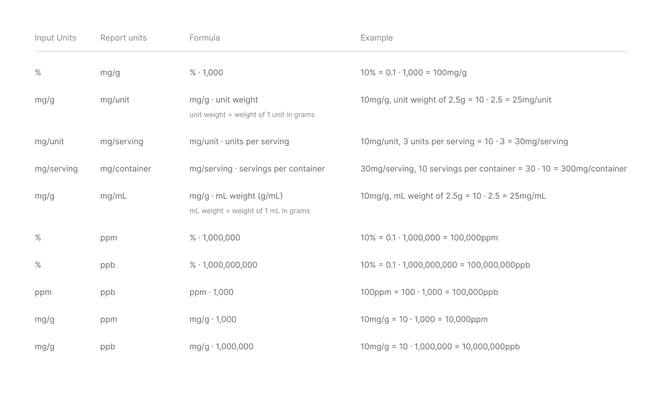
To report results in the below units, ensure the following fields are populated:
| Desired Unit | Required Fields |
|---|---|
| mg/ml | Density (g/mL) |
| mg/unit | Unit Weight |
| mg/serving | Unit Weight, Units Per Serving |
| mg/container | Unit Weight, Units Per Serving, Servings Per Container |
What Is a “Unit”?
A unit is defined as the smallest measurable or divisible component of a product.
Example: A Chocolate Bar with 10 pieces
- Unit Description: 1 piece of chocolate
- Unit Weight: Weight of 1 piece of chocolate
- Units Per Serving: Number of pieces per serving (e.g., 1)
- Servings Per Container: 10
- Container Description: 1 chocolate bar
This is the recommended approach, as it keeps values intuitive and avoids fractional inputs.
Using the Container as the Unit
Labs may choose to define the unit as the full container (e.g., 1 chocolate bar). This is supported, but may require fractional values.
Example: Unit = Full Chocolate Bar
- Unit Description: 1 chocolate bar
- Unit Weight: Weight of the full chocolate bar
- Units Per Serving: 0.1 (if 1 serving = 1 piece out of 10)
- Servings Per Container: 10
- Container Description: 1 chocolate bar
Note:
When the unit is defined as the full container, Units Per Serving may be a fractional value. This is expected and allows the system to correctly calculate per-serving and per-container values.
Key Takeaway
For the most straightforward setup, we recommend:
- Defining the unit as the smallest component (e.g., 1 piece, 1 gummy, 1 capsule)
- Using whole numbers for Units Per Serving whenever possible